


Robinhood found a new growth engine. Morgan Stanley sees 28% upside

Robinhood $HOOD reported second-quarter revenue of $156 million from event contracts, i.e. contracts on the outcomes of sporting events, economic data, and political events. That's more than the company earned from stock trading ($129 million) and crypto ($100 million), and the product was used by just under 2 million of 28.4 million customers. Crypto revenue fell 38% year over year, yet total revenue grew 32% to a record $1.31 billion.
Key points
Event contracts brought in $156 million for the quarter, more than crypto or stock trading. Yet they are used by just under 2% of customers, and in July, contract volume fell month over month for the first time.
Crypto revenue fell 38%, yet total revenue grew 32% to a record $1.31 billion. But July data shows a weakness: net revenue from securities lending dropped from $37 million to $1 million.
In the record net profit of $573 million, about $129 million comes from the deconsolidation of a fund. Moreover, operating expenses jumped 33%, nearly as fast as revenue.
The Ninth Circuit Court ruled that sports contracts are bets, and the ruling directly affects Robinhood. Sports contracts are no longer available in Maryland, and new positions cannot be opened in Nevada.
The stock trades around $117 at roughly 52 times earnings, with bank price targets between $136 and $160. Morgan Stanley's model assumes revenue of $8 billion and an EBITDA margin of 53% only by 2028.
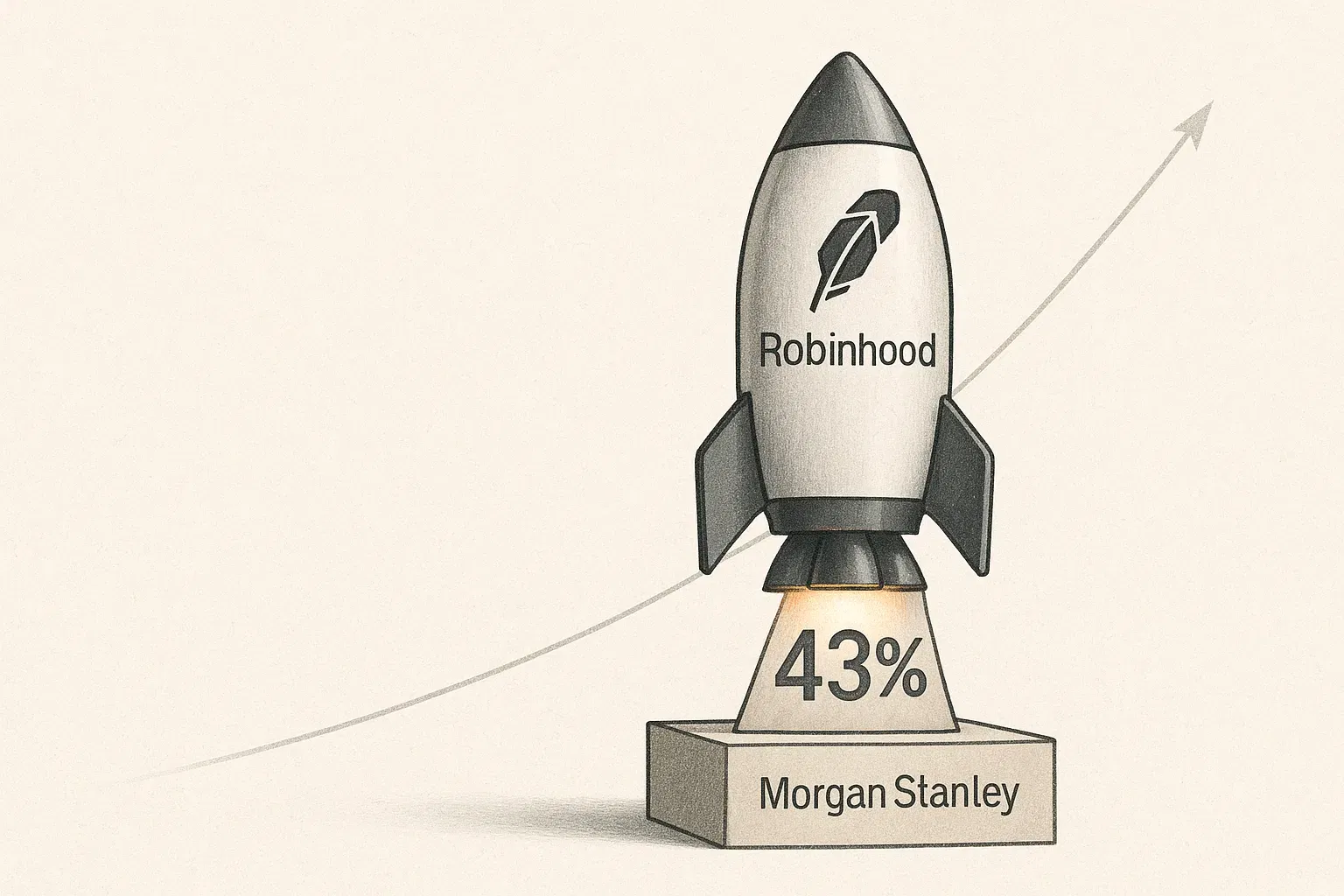
Morgan Stanley responded last week by upgrading the stock to Overweight and raising the price target from $124 to $150, saying the market underestimates the monetization of the existing customer base. At the end of August, the Ninth Circuit Court ruled that sports event contracts are not financial derivatives but bets, which individual states may regulate. That decision also affects Robinhood.
How Robinhood makes money on who wins a game or an election
Revenue from event contracts grew more than tenfold year over year to $156 million. Behind that jump is a product that looks like trading in the app, but the money is generated differently.
Robinhood acts as an intermediary to the customer and routes orders to several exchanges, including Kalshi, ForecastEx, and, since June, Rothera. Rothera is an exchange and clearinghouse licensed by the CFTC, independently managed through a joint venture between Robinhood and Susquehanna International Group. It is strategically important for the company because it gives Robinhood greater control over the infrastructure and economics of prediction markets than merely routing orders to third-party exchanges. Each contract trades for a penny within a range of up to one dollar, and at settlement it is worth either a dollar or zero.
This small unit explains the numbers that at first glance seem nonsensical. Customers traded 13.6 billion contracts in Q2, more than ten times year over year. Since June, Robinhood charges its own commission based on the contract price, at most one cent per contract, and the exchange itself may add another fee. Dividing $156 million in revenue by 13.6 billion traded contracts yields an average of about 1.1 cents of revenue per contract. However, this calculation is not identical to the customer-facing fee schedule, and the company does not disclose the separate economics of individual contract types.
Rothera launched operations in June, and in its first few weeks more than 3.5 billion contracts passed through it, quickly placing it among the largest prediction exchanges in the world.
Economically, it is an unusual product for a broker. A stock trade generates one-time income and then the customer holds the position for months. A contract on the outcome of a game or on Friday's labor market data opens and expires within hours, so the same customer pays a fee again and again, possibly several times a week. Thus, just under 2 million prediction market users generated more revenue than the entire stock trading segment.
But fresh data shows the curve is not a straight line. In July, customers traded 6.1 billion contracts, 5% less than in June. The year-over-year comparison shows a twenty-fold increase, but in July last year the product practically did not exist. Therefore, the comparison with previous months is more telling, and it has been stagnating so far. Moreover, summer falls outside the main sports season, so the real test will come with the autumn numbers.
Robinhood itself does not publish any outlook for this segment and does not report its profitability. From public data, it is impossible to determine whether the $156 million is generated with a margin comparable to the rest of the company, or whether growth is so far driven by marketing and fee discounts.
Weak crypto for the first time did not mean a weak quarter
Until last year, the rule was that when crypto cools, Robinhood's results cool too. In the second quarter, that rule failed for the first time. Crypto volumes in the app fell 35% year over year to $18 billion, segment revenue dropped to $100 million, and yet the company posted its best quarter ever.